
Rafael Monroy Casas
Sus libros

La pronunciación del inglés británico simplificada
Un libro muy útil para aprender correctamente la pronunciación británica, explicada con sencillez y con muchos ejemplos. Se comprende todo fácilmente, y el temario es muy completo. Se explican detalladamente todos los fonemas, los fonemas en cadena, el acento, el ritmo y la entonación. Recomendado para cualquier estudiante de inglés que quiera mejorar su pronunciación. Además, incluye un CD con archivos de audio para hacer más fácil el aprendizaje.
(Leonor, 2016. Amazon, 5.0 de 5 estrellas)
Es el primer libro que encuentro en el que se plantea en serio el problema. Todos son cursos con medios audiovisuales con mayor o menor fortuna. Trabajo como cardiólogo y a veces me encuentro situaciones embarazosas con pacientes extranjeros.
(Miguel, 2012)

Aspectos fonéticos y fonológicos de las vocales españolas
En Aspectos fonéticos y fonológicos de las vocales españolas, se analizan diversos ámbitos problemáticos relacionados con el vocalismo hispánico. Configuran el volumen varios trabajos de tipo experimental realiza-dos por el autor sobre el comportamiento fonético y fonológico de las vocales en español. Se trata de análisis críticos de las opiniones al uso sobre aspectos tales como la duración en español, la existencia o no de alófonos en nuestro sistema, el comportamiento vocálico de (h)i/y-(h)u y su reflejo fonémico, la fonética y fonología de las conjunciones y/u, la caracterización del acento en español, etc.
El texto es una reedición y actualización del libro que, con el título Aspectos fonéticos de las vocales españolas, se publicó en 1980.
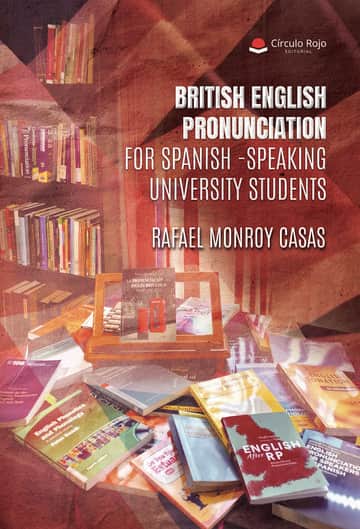
BRITISH ENGLISH PRONUNCIATION
This textbook is meant for Spanish-speaking university students: undergraduates and graduates in English Philology, students in advanced courses at Official Language Schools and Teacher Training Colleges, and, in general, all those who have a fair knowledge of the inner workings of the English language and wish to delve further into the intricacies of English pronunciation. It departs in many ways from other textbooks in the market in that it focuses on just one variety of British English –General RP– a controversial name by which British phoneticians and linguists, in general, refer to the most prestigious accent spoken mainly, but not exclusively, in the south of England. Aware of the omnipresent role played by the mother tongue in foreign language learning by adults, we approach the subject from a contrastive standpoint; thus, we have chosen to present English pronunciation against the backdrop of Castilian Spanish (referred to in the book simply as Spanish). Another aspect in which this book differs from similar publications in the market is the incorporation of some of G. Lindsey’s views on current RP. The arrival of his English After RP. Standard British Pronunciation Today (2019) has meant, if not an earthquake, a rethinking of many of the postulates unquestionably repeated decade after decade in the textbooks in use. The reader will also note that no mention is made of ‘phonetics’ or ‘phonology’ in the title of the book and that ‘pronunciation’ is used instead. Naturally, the former underlies everything related to the latter. Although it is undoubtedly helpful to include some introductory chapters on the foundations of articulatory, acoustic, and even auditory phonetics, coupled with some brief notions on phonology as some textbooks do, we have decided to take from these disciplines just those aspects that can have a direct bearing on the knowledge and mastery of British English pronunciation. While language is an undifferentiated whole, pedagogical reasons have led us to organise the subject into five main sections. Thus, after an introductory chapter on the type of accent discussed, we briefly describe the different systems of phonetic representation in English. It follows a Unit covering the English syllabic structure and phonological processes in context. Monophthongs, diphthongs and diphthong-like sequences are addressed in Units 4 and 5. In Units 6 and 7, we deal with approximants and nasals, respectively, while fricatives, affricates and plosives are covered separately in Units 8, 9 and 10. The following chapters deal with English lexical stress, rhythm, and intonation. As appendices, we include a list of words of French origin with their corresponding pronunciation, as well as London Tube stations whose pronunciations may be problematic to the foreign learner; a third section lists Anglo-American toponyms with an atypical pronunciation, and finally, there follows a list of Latin expressions used in academic language.