
Dezhi Xue Wu
Dezhi Xue Wu es doctor en Medicina (Ph.D.) por la Universidad de Medicina Tradicional China de Nanjing, especializado en acupuntura y medicina tradicional china. Combina la investigación teórica con la práctica clínica, explorando los fundamentos de la acupuntura y su integración con la medicina moderna.
Sus libros
Proyección
Proyección: La iteración de la civilización
En Proyección: La iteración de la civilización, Dezhi Xue Wu propone una nueva manera de comprender el momento histórico que atraviesa la humanidad. Más que un libro sobre un futuro lejano, es una reflexión sobre un cambio de civilización que ya ha comenzado.
Cada civilización ha creído encontrarse en la culminación de su propia historia. Sin embargo, la historia muestra una realidad distinta: ninguna representa un punto de llegada definitivo. Todas nacen, evolucionan, se transforman y dan paso a nuevas formas de organización. La civilización no avanza de manera lineal; progresa mediante sucesivas iteraciones.
La inteligencia artificial, la automatización, la transición energética y la expansión de la capacidad computacional no aparecen aquí como simples innovaciones tecnológicas, sino como manifestaciones de una transformación mucho más profunda: el surgimiento de una nueva etapa en la evolución de la civilización humana.
Desde una perspectiva que integra filosofía, historia, pensamiento sistémico y análisis intercultural, el autor examina cómo cada gran revolución tecnológica redefine no solo la economía y la producción, sino también la forma en que las sociedades se organizan, ejercen el poder y comprenden el significado de ser humano.
Cuando la inteligencia deja de ser una capacidad exclusivamente humana, las preguntas fundamentales ya no son únicamente tecnológicas, sino también filosóficas y civilizatorias. ¿Qué lugar ocupará el trabajo en una sociedad altamente automatizada? ¿Cómo cambiará el poder cuando la energía, la infraestructura digital y la capacidad computacional se conviertan en los principales recursos estratégicos? ¿Podrá una civilización desaparecer no por la guerra, sino por quedar excluida de las redes que sostienen el nuevo orden tecnológico?
A través del análisis histórico, la reflexión filosófica y el diálogo con sistemas de inteligencia artificial, la obra explora una cuestión más profunda: cómo evolucionan las civilizaciones y qué fuerzas impulsan cada una de sus transformaciones. La tecnología deja de entenderse como un destino inevitable para convertirse en una expresión del propio desarrollo de la conciencia humana.
Lejos tanto del entusiasmo tecnológico como del catastrofismo, Proyección: La iteración de la civilización propone una reflexión sobre el futuro de la humanidad desde una perspectiva histórica, filosófica y sistémica. Más que intentar predecir el porvenir, busca comprender los patrones profundos que han guiado el nacimiento, la expansión, la transformación y la renovación de las civilizaciones a lo largo de la historia.
Porque la cuestión decisiva no es qué máquinas construiremos en el futuro, sino qué clase de civilización construiremos junto a ellas.
Unfolding
Unfolding: The Iterative Paths of Civilization
Every civilization believes it stands at the height of its own achievement. Yet history suggests a different pattern: civilizations do not reach a final destination—they unfold. Each age carries within itself the conditions that give rise to the next, reshaping how human beings understand work, power, knowledge, and ultimately themselves.
Unfolding: The Iterative Paths of Civilization explores this continuing process of transformation at a moment when humanity is entering one of the most profound transitions in its history. Artificial intelligence, automation, renewable energy, advanced computation, and intelligent machines are not presented as isolated technological breakthroughs, but as signs of a broader civilizational shift. The book asks a deeper question: what becomes of humanity when intelligence, productivity, and decision-making are no longer uniquely human?
Drawing on philosophy, history, systems thinking, economics, political analysis, and dialogues with artificial intelligence, Dezhi Xue Wu examines how every technological revolution reorganizes civilization itself. As industrial society gives way to an era increasingly shaped by physical AI and autonomous systems, traditional assumptions about labor, wealth, sovereignty, education, and even human identity begin to change. The central challenge is therefore not technological, but civilizational.
Rather than offering predictions about the future, the book explores the enduring patterns through which civilizations emerge, mature, fragment, and reorganize. It considers questions that will define the coming century. What gives meaning to human life when work is no longer its primary organizing principle? How will nations exercise power when computation, energy, and intelligent systems become the foundations of strategic influence? Can societies lose their place in history not through military conquest, but by becoming disconnected from the technological networks upon which civilization increasingly depends?
Throughout the book, technology is understood not as an external force, but as an extension of human consciousness. Every new tool transforms not only what people can do, but also how they perceive the world, organize society, and define themselves. The emergence of artificial intelligence therefore represents more than a technological revolution; it marks a new stage in the long unfolding of civilization itself.
Neither optimistic nor dystopian, Unfolding offers a philosophical exploration of humanity's future in an age of accelerating change. It argues that the greatest questions of the twenty-first century are not simply about machines, but about civilization, meaning, and the enduring place of human consciousness within an increasingly intelligent world. Rather than predicting what the future will look like, the book seeks to understand the deeper patterns through which every future comes into being.
The Tao of Chinese Medicine
The Tao of Chinese Medicine: From Classical Foundations to Modern Scientific Perspectives
For more than two thousand years, Chinese medicine has sought to answer a question that remains central to medicine today: What enables life to maintain health? Long before modern physiology described homeostasis, adaptation, and systems regulation, Chinese physicians had developed a sophisticated framework for understanding how the human body preserves balance, responds to change, and recovers from illness.
The Tao of Chinese Medicine offers a fresh and intellectually rigorous interpretation of Traditional Chinese Medicine (TCM), presenting it not as mysticism or cultural tradition, but as a coherent medical philosophy grounded in careful observation, clinical experience, and a systemic understanding of life. Drawing together classical texts, historical development, modern scientific research, and decades of clinical practice, the book re-examines Chinese medicine through the lens of contemporary knowledge while remaining faithful to its original principles.
Rather than treating TCM as a collection of isolated therapies, the author reveals its underlying logic as an integrated system for understanding health, disease, and human adaptation. Concepts such as Yin–Yang, the Five Phases, Qi, Blood, the Zang–Fu organs, and the meridian network are presented as functional models that describe regulation, interaction, and dynamic balance within living systems—not as metaphysical abstractions or symbolic beliefs.
From this perspective, acupuncture, herbal medicine, tuina, dietetics, emotional regulation, and Yang Sheng share a common purpose: they do not simply fight disease but seek to restore the body's intrinsic capacity for self-regulation. Disease is understood less as an external enemy than as the gradual disruption of physiological order. Healing, therefore, is the process of re-establishing the conditions in which life can recover its own balance and resilience.
The book also builds a dialogue between Chinese medicine and modern science. Drawing on advances in neuroscience, fascia research, mechanotransduction, neurophysiology, chronobiology, and systems biology, it explores how contemporary scientific discoveries can illuminate the mechanisms underlying acupuncture, functional disorders, and the body's remarkable capacity for adaptation. Rather than forcing ancient theory into modern terminology, the discussion allows each tradition to enrich the other while respecting their distinct perspectives.
At a time when chronic disease, aging, stress-related disorders, and functional illnesses have become defining challenges of global healthcare, the classical principle of Zhi Wei Bing—preventing illness before it arises—offers renewed relevance. Through discussions of circadian rhythms, lifestyle, emotional balance, and preventive care, the book demonstrates that Chinese medicine is fundamentally concerned not only with treating disease, but with preserving the conditions that allow healthy life to flourish.
Rather than positioning Chinese medicine as an alternative to modern biomedicine, The Tao of Chinese Medicine argues that the two traditions address different, yet complementary, dimensions of health. Modern medicine has transformed our understanding of structural pathology and acute disease; Chinese medicine offers profound insights into regulation, adaptation, resilience, and the dynamic processes that sustain living systems. Together, they provide a broader and more complete understanding of medicine than either can achieve alone.
Written for physicians, researchers, students, and readers interested in the future of healthcare, The Tao of Chinese Medicine invites a reconsideration of what medicine truly is—not merely the treatment of disease, but the science and art of understanding life itself.
All Things in Tao
All Things in Tao: Eastern Wisdom and the Hidden Order of Life is a profound exploration of the universal principles that govern the cosmos, life, and human civilization. Bridging the wisdom of ancient China with the discoveries of modern science, Dr. Dezhi Xue Wu traces a continuous thread from Wuji, the undifferentiated origin of existence, to the emergence of Taiji, the evolution of life, and the hidden order that sustains all living systems.
Drawing on Taoist philosophy, Traditional Chinese Medicine, systems science, neuroscience, thermodynamics, and complexity theory, the book presents a unified vision of reality in which Qi, Yin–Yang dynamics, the Five Phases, meridian networks, and the triad of Jing–Qi–Shen are understood not as isolated cultural concepts, but as expressions of universal principles of organization, regulation, and renewal. Rather than presenting Chinese medicine as a collection of therapeutic techniques, the author reveals it as a comprehensive philosophy of life—one that resonates with contemporary understandings of energy, information, self-organization, and biological order.
At the heart of the book lies a central proposition: life is fundamentally a self-organizing, low-entropy process. Health is the dynamic maintenance of this order, while disease reflects its gradual disruption. From this perspective, nourishing Jing, regulating Qi, harmonizing the meridians, and cultivating Shen are not merely therapeutic practices, but fundamental principles for preserving the integrity and resilience of living systems. The same patterns that sustain the human body, the author argues, also shape the emergence, flourishing, and decline of civilizations.
Looking beyond medicine, All Things in Tao explores the future of human development in an age of biotechnology, regenerative medicine, artificial intelligence, and human–machine integration. As technological progress accelerates, it raises a deeper question: can civilization continue to advance without losing the natural order upon which life itself depends? The book suggests that the Tao offers not only an ancient philosophy, but a timeless framework for understanding how complexity, intelligence, and harmony emerge—and how they may be sustained in the future.
Written for scientists, physicians, philosophers, and readers seeking a deeper understanding of life, All Things in Tao offers a compelling dialogue between Eastern wisdom and contemporary science. It invites us to reconsider not only the nature of health, but also the future of consciousness, civilization, and humanity itself, through the enduring principle of the Tao—the hidden order that connects all things.
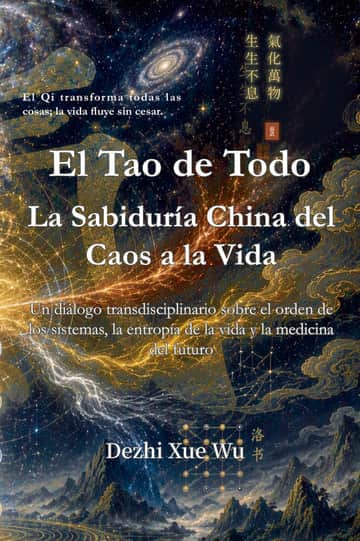
El Tao de Todo La Sabiduría China del Caos a la Vida
¿Y si el Big Bang, el Yin-Yang, el Qi de la medicina china y la entropía de la física fueran, en el fondo, la misma historia contada en dos idiomas distintos?
El Tao de Todo parte de una pregunta tan antigua como el propio Tao Te Ching —¿cómo nace el orden a partir del caos?— y la persigue a través de la cosmología, la física, la cibernética de sistemas y la medicina china, hasta llegar a una visión inédita de la salud: el cuerpo humano como un sistema que lucha, momento a momento, contra la entropía.
Desde el Wuji y el Taiji hasta los meridianos y el reloj biológico, desde las células madre hasta la emergencia de la conciencia, el libro traza un mapa único donde el Jing, el Qi y el Shen dejan de ser metáforas y se convierten en variables de un mismo sistema vivo —el mismo que hoy la ciencia de la complejidad intenta describir con otro vocabulario.
Un diálogo riguroso y ambicioso entre lo clásico y lo científico, escrito por un médico con más de veinte años de práctica clínica, que propone nada menos que una nueva forma de entender —y de practicar— la medicina del futuro.
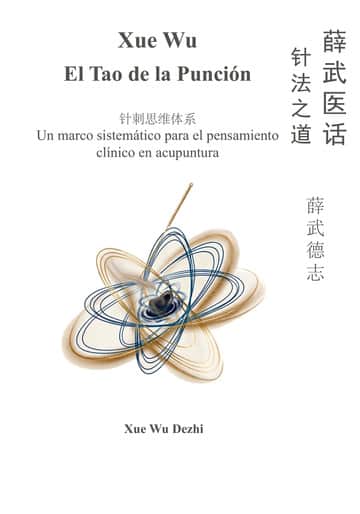
Xue Wu El Tao de la Punción
La técnica puede volverse cada vez más compleja, la teoría más profunda y los instrumentos más avanzados, pero lo que tenemos delante, al final, sigue siendo un ser vivo.
El Tao de la Punción es un marco sistemático para el pensamiento clínico en acupuntura. En lugar de presentar la punción como un conjunto de recetas y puntos, el libro la aborda como un modo de pensar: cómo observar al paciente, cómo decidir dónde, hasta qué profundidad y en qué momento actuar, y cómo leer y acompañar el movimiento del qi con la aguja.
A partir de las fuentes clásicas, entre ellas el Neijing, el Lingshu y el Nanjing, y de más de veinte años de práctica clínica y docente, el Dr. Dezhi Xue Wu ordena los principios básicos de la acupuntura, la dirección, el espacio y el tiempo como ejes de reflexión, y las técnicas de manipulación de la aguja. Todo ello con un lenguaje claro y un objetivo práctico: que el terapeuta pueda justificar cada gesto con una lógica clínica.
Una obra dirigida a acupuntores, estudiantes avanzados y profesionales de la medicina china que quieran pasar de aplicar técnicas a comprender y dominar el arte de la punció